By Cohen Law Group | September 2026
Last week, the Florida Senate’s general counsel sent the Orlando Sentinel and the South Florida Sun Sentinel a demand most Floridians would expect from a private company guarding its secrets, not from their own Legislature. The newspapers were ordered to stop using a state-commissioned report on property insurer finances, shred every copy, tell anyone they shared it with to do the same, and certify the destruction within 48 hours. The letter warned that any further use of the records could be a third-degree felony.
The newspapers refused, and every Florida homeowner who has fought an insurer over a denied or underpaid claim should pay attention to what that report says.
What the Report Found
The document is an Affiliated Fee Analysis commissioned by the Florida Office of Insurance Regulation (OIR) in 2020 and 2021 at a taxpayer cost of roughly $150,000. Connecticut-based Risk & Regulatory Consulting reviewed 53 property insurers with a significant presence in Florida. It examined the fees those insurers pay to their own affiliates: sister companies under common ownership that handle claims, policy administration, commissions, and investments.
According to the Sentinel’s reporting, the consultant found:
- 20 insurers paid affiliate fees that presumptively failed Florida’s “fair and reasonable” standard. Nineteen were state or regional carriers.
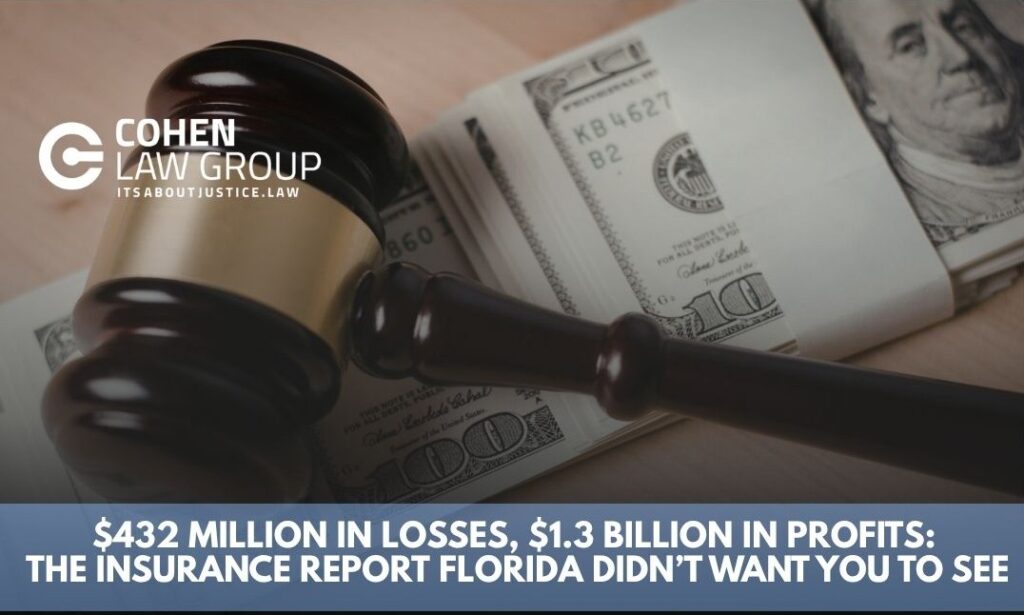
- $432 million in reported losses vs. $1.3 billion in affiliate profit. From 2017 to 2019, excluding several outliers, the insurers reported $432 million in losses while the fees they paid generated $1.3 billion in net income for their affiliates.
- Company by company, the pattern repeats. Universal Property & Casualty and its sibling American Platinum reported a combined $11.1 million loss while an affiliate earned about $166 million. Heritage reported nearly $81 million in losses while its affiliates earned $174 million. FedNat and a subsidiary reported $42 million in losses while its affiliates made at least $79.4 million.
- Fees tied to premium, not services. Affiliated managing general agents charged 20% to 34% of premium, and total affiliate fees reached as high as 63%.
- Failed carriers failed the test. Gulfstream, Avatar, and FedNat all flunked the consultant’s analysis. All three later collapsed, leaving their policyholders scrambling. FedNat was declared insolvent in 2022.
Why the Timing Matters
OIR had this analysis in hand while the Legislature debated the 2022 and 2023 property insurance reforms. Those laws eliminated one-way attorney’s fees for policyholders who win against their insurer, ended assignment of benefits for new policies, shortened claim deadlines, and added pre-suit hurdles. The justification lawmakers heard over and over was that insurers were bleeding money. Lawmakers later said the findings were hidden from them while they voted.
As Orlando Sentinel columnist Scott Maxwell points out, the promised relief was slow to arrive: policy prices rose for nine consecutive quarters after the reforms passed, and some insurer CEOs took home as much as $21 million right after the industry said it could barely make ends meet. The public learned the company-by-company details only this summer, when the Senate included the full report in its response to a Sentinel request for legislative emails. OIR’s own copy, produced in August, was heavily redacted under trade secret claims.
Insurance Commissioner Michael Yaworsky calls the analysis a flawed draft, but OIR has declined to identify the supposed errors. Earlier this year, the House passed bills increasing oversight of affiliate payments. They died in the Senate: the same chamber now threatening reporters.
The Senate’s Demand Does Not Hold Up
In Florida Star v. B.J.F., 491 U.S. 524 (1989), a Florida case, the U.S. Supreme Court held that a newspaper could not be punished for publishing truthful information that a government agency itself had mistakenly released. If the government fails to protect its own information, the fix is better procedures, not punishing the press. The Sentinel obtained these records through Florida’s public records process. Barbara Petersen of the Florida Center for Government Accountability called the Senate’s letter an attempt to chill and intimidate. That is exactly what it is.
What This Means for Your Claim
Many Florida insurers do not adjust claims themselves. An affiliated company does, and that affiliate is often paid a percentage of the premium you pay, not a fee for doing the work well. Its revenue does not go up when your claim is paid fairly. When your insurer says it cannot afford to pay your full claim, remember that it may be routing a large share of every premium dollar to sister companies whose books you are not allowed to see.
That is why a lowball estimate or a denial letter should never be treated as the final word. Practical steps:
- Document everything. Photograph the damage, keep receipts, request your certified policy, and save every communication from the insurer and its adjusters.
- Get your own estimate. The insurer’s estimate comes from the insurer or its affiliate. An independent estimate gives you a real benchmark.
- Watch the deadlines. Under section 627.70132, Florida Statutes, notice of a new or reopened claim generally must be given within one year of the date of loss, and a supplemental claim within 18 months. Section 627.70152 requires written notice of intent to litigate at least 10 business days before filing suit. Missing these deadlines can end your claim.
Maxwell closes his column with the right question: what if state officials pursued insurers that break the rules and deny valid claims as aggressively as they pursued the journalists who exposed them? Until that happens, the best protection you have is an attorney who knows how insurers operate and holds them to the policy they sold you.
| Denied or Underpaid? Talk to Cohen Law Group.
Cohen Law Group represents Florida homeowners and businesses statewide in property insurance disputes. We handle cases on a contingency-fee basis: you pay no attorney’s fees unless we recover for you. Call (407) 478-4878 for a free case review. |
Sources: Skyler Swisher, Ron Hurtibise, and David Fleshler, “How Florida fights to hide insurers’ finances,” Orlando Sentinel (Sept. 19, 2026); Scott Maxwell, “Florida hid insurance industry’s lies — and tried to stop us from revealing them,” Orlando Sentinel (Sept. 22, 2026).
Disclaimer: This article is for general informational purposes only and does not constitute legal advice. Reading it does not create an attorney-client relationship. Every claim depends on its own facts and policy language; consult a licensed Florida attorney about your situation. The hiring of a lawyer is an important decision that should not be based solely upon advertisements. Past results do not guarantee a similar outcome.
SEO
Meta Title: The Insurance Report Florida Didn’t Want You to See | Cohen Law Group
Meta Description: The Florida Senate demanded newspapers shred a state report showing insurers claimed losses while their affiliates netted $1.3 billion. What it means for your claim.
URL Slug: /florida-senate-newspapers-insurer-affiliate-fee-report
Focus Keyword: Florida property insurance affiliate fees
Secondary Keywords: Florida insurance claim denied, underpaid hurricane claim Florida, Florida property insurance lawyer, OIR affiliated fee analysis, Heritage Universal affiliate fees, Maitland insurance attorney