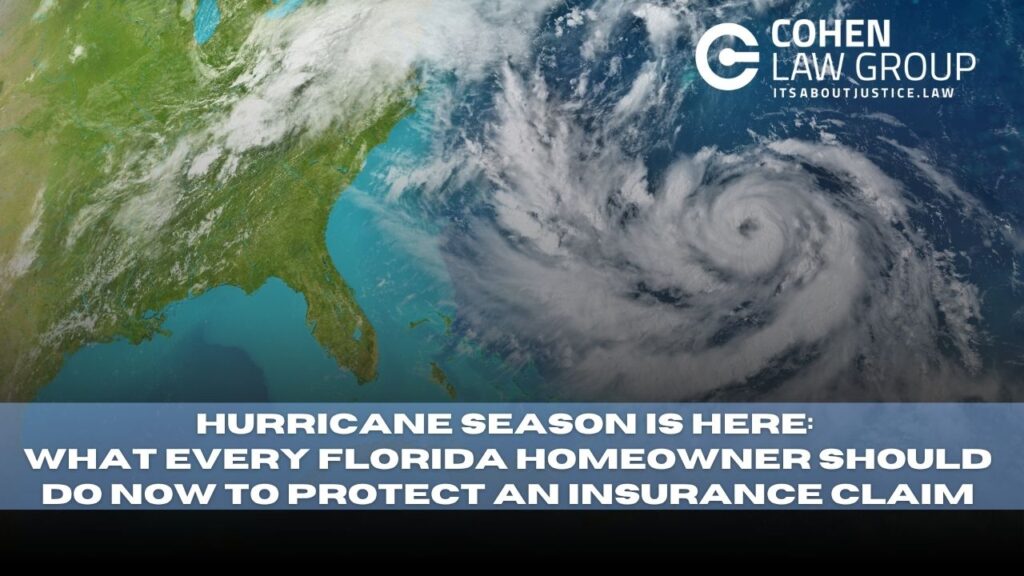
Florida’s disaster season is officially underway. The Atlantic hurricane season runs from June 1 through November 30, and forecasters are again warning of a busy summer along the Gulf and Atlantic coasts. When a hurricane peels the shingles off your roof or drives water through your walls, your insurance policy is supposed to be the safety net that helps you rebuild. But far too many Florida homeowners learn what their policy actually covers only after the storm has passed — and only after the insurance company has already started building its case to pay less than the claim is worth.
The encouraging news is that a little preparation now can dramatically strengthen your position later. Here is what you should do before the next named storm makes landfall.
Start Here: Get a Complete Copy of Your Policy — and Actually Read It
Before anything else, make sure you have a full, current copy of your homeowners policy in hand. Not just the one-page renewal notice or the premium bill — the complete policy, including the declarations page and every endorsement, rider, and exclusion attached to it. Many homeowners have never seen their actual policy, and a surprising number cannot locate it at all. If that describes you, request a certified copy from your agent or carrier today. As a Florida policyholder, you are entitled to a copy of the contract you are paying for, and there is no reason to wait until a storm is bearing down to ask for it.
Once you have it, read it — or at least the parts that will matter most after a loss. Start with the declarations page, the summary at the front that lists your coverage limits and, critically, your deductibles. Most Florida policies carry more than one deductible: a standard all-other-perils deductible for everyday claims, plus a separate hurricane or named-storm deductible that applies only to storm damage. These are not the same number, and the difference can be enormous.
Pay especially close attention to that hurricane deductible. Under section 627.701, Florida Statutes, hurricane deductibles are calculated as a percentage of your dwelling limit — commonly 2%, 5%, or even 10% — rather than a flat dollar amount. On a home insured for $400,000, a 5% hurricane deductible means $20,000 comes out of your own pocket before the insurer pays a dime. Many homeowners have no idea their deductible works this way until they are staring at the number after a storm. Know it now, in advance, so there are no surprises.
While you are in the policy, look closely at the exclusions and any sublimits and endorsements. This is where insurers quietly limit what they will pay. Watch for reduced sublimits on things like mold, screen enclosures and pool cages, and detached structures; for roof endorsements that pay only actual cash value (depreciated value) on an older roof instead of full replacement cost; and for ordinance-or-law coverage, which affects whether the insurer pays to rebuild to current Florida Building Code. If any of these limits look too low for your home, now — not after a hurricane — is the time to talk to your agent about adjusting them.
Know Exactly How Much Coverage You Actually Have
With policy in hand, ask the most basic question: if your home were destroyed tomorrow, would it pay enough to rebuild? Underinsurance is a chronic problem nationwide, and Florida is no exception. Consumer advocates have found that roughly half of homeowners do not carry enough coverage to fully replace their homes after a total loss. Construction costs have climbed sharply in recent years, and a dwelling limit that was adequate five years ago may leave a serious gap today. If you know a contractor or builder, ask what it costs per square foot to rebuild in your area right now, then compare that figure against your Coverage A dwelling limit.
Check whether your policy pays replacement cost value or actual cash value on the structure itself. Actual cash value subtracts depreciation, which can leave you with a fraction of what it costs to repair an aging roof or home. Replacement cost coverage is almost always worth the higher premium in a state where roofs take a beating.
Confirm, too, that your policy includes loss-of-use coverage (Coverage D), which pays additional living expenses if your home becomes uninhabitable. Ask yourself what it would cost to house your family in a rental or hotel for three weeks, three months, or longer, and make sure your limits reflect that reality.
And remember the single most important gap in Florida: flooding is not covered by a standard homeowners policy. Storm surge and rising water require a separate flood policy, most often through the National Flood Insurance Program. Because new NFIP policies typically carry a 30-day waiting period, buying coverage as a storm approaches is too late. If you live anywhere near the coast or a floodplain, this is not optional.
Get Your Documentation in Order Before the Storm
The single best thing you can do to protect a future claim is to document your home while it is still intact. After a hurricane, one of the most common insurer tactics is to argue that damage was pre-existing, cosmetic, or the result of ordinary wear and tear rather than the storm. A clear record of your home’s condition before the loss is the most effective way to rebut that argument.
Walk through your house and property with your phone and record a video, room by room, at least once a year. Narrate what you are showing — the age and condition of the roof, appliances, flooring, cabinetry, electronics, and any high-value items. Open closets and cabinets. Capture serial numbers where you can. This inventory becomes invaluable when you are asked to prove what you owned and what condition it was in.
Store the essentials somewhere you can reach them even if your home is gone: your complete insurance policy and declarations page, identification, a list of emergency contacts, any prescription medications your family relies on, and financial information such as account and card details. Keep these in the cloud or on a small drive you can grab in seconds. In the chaotic days after a disaster, being able to instantly answer your insurer’s questions can be the difference between a claim that moves and one that stalls.
Keep Up With Maintenance — Because Your Insurer Is Watching
Next, handle straightforward home maintenance: trim tree limbs that overhang the house, keep gutters and roofs clear of debris, and address small problems before they become big ones. This matters for more than just preventing damage.
Most policies do not affirmatively require you to prune your trees or scrub your roof. What they do contain is an exclusion for damage caused by neglect or a homeowner’s failure to maintain the property. Insurers lean on that language constantly, recharacterizing storm damage as long-term deterioration so they can deny or slash a claim. Regular, documented upkeep takes that argument away from them.
Understand, too, that Florida insurers are increasingly watching your property from the air. Carriers routinely use drones, satellites, and aerial imagery to inspect roofs — often without the homeowner’s knowledge — and they are using what they find to justify non-renewals and to deny claims for supposedly pre-existing roof conditions. A stained or slightly worn roof in an aerial photo can become the insurer’s excuse to walk away. Keeping your roof and property in good repair, and keeping your own dated photos, is your best defense against a flyover you never agreed to.
A Few More Ways to Get Ahead of the Storm
Beyond the essentials above, a handful of additional steps can put you in a much stronger position if disaster strikes:
Learn your claim deadlines. Florida law is strict about timing. Under section 627.70132, Florida Statutes, you generally have just one year from the date of loss to file a hurricane or windstorm claim, and 18 months to file a supplemental claim. Miss those windows and even a valid claim can be barred. Know them before you ever need them.
Save your carrier’s claim information offline. Write down your policy number, your agent’s contact information, and your insurer’s claims hotline, and keep them somewhere you can reach without power or internet. Reporting your claim promptly and keeping a log of every call, adjuster, and claim number will serve you well later.
Set aside cash for your deductible. Because Florida hurricane deductibles run into the thousands or tens of thousands of dollars, and because insurers can be slow to advance funds, having an emergency reserve lets you begin emergency repairs and temporary housing without waiting on the carrier.
Get a wind mitigation inspection. A licensed inspection documents storm-resistant features of your home — roof-to-wall connections, roof-deck attachment, and opening protection — and can qualify you for meaningful premium credits that Florida insurers are required to offer. As a bonus, it creates a dated, professional record of your roof’s condition before any storm.
Be careful what you sign after a storm. In the frantic days after a hurricane, homeowners are often pressured to sign contracts or documents that hand over or limit their claim rights before they understand what they are agreeing to. Slow down. Before you sign anything that assigns your benefits or your recovery to a contractor or vendor, make sure you understand exactly what you are giving up.
When the Insurance Company Doesn’t Play Fair, We Do
Even the most prepared homeowner can be lowballed, delayed, or denied. If you have done everything right and your insurance company still refuses to pay what your policy promises, you do not have to fight them alone. At Cohen Law Group, we represent Florida policyholders — never the insurance companies — in first-party property insurance disputes across the state. We work on a contingency-fee basis, which means you pay no attorney’s fees unless we recover for you. If your hurricane, wind, or water claim has been underpaid or wrongfully denied, call us for a free case review before you accept the insurer’s answer as final.
This blog post is provided for general informational purposes only and does not constitute legal advice, nor does it create an attorney-client relationship. Insurance policies, coverages, deductibles, and statutory deadlines vary, and the facts of every claim are different. You should consult a licensed Florida attorney regarding your specific situation before making any decisions about your insurance claim.
SEO Metadata
Meta Title: Hurricane Season Prep: How Florida Homeowners Can Protect an Insurance Claim
Meta Description: Before the next Florida hurricane, get a copy of your policy and review your deductibles, verify your coverage, document your home, keep up maintenance, and know your claim deadlines to protect your property insurance claim.
Target Keywords: Florida hurricane insurance, hurricane deductible Florida, review homeowners policy, property insurance claim, underinsurance, flood insurance NFIP, claim deadline 627.70132, wind mitigation credit, denied insurance claim Florida, first-party property insurance attorney
Suggested URL Slug: /Florida-hurricane-season-insurance-preparation